When AI Does the Work, Who Owns the Outcome?
A Practical Guide to Accountability, Workforce Design, and Measurable Business Results — by Donna Lightfoot, creator of The Ownership Gap™.
AI can automate a task. That does not mean it resolved the need.
Organizations are rapidly introducing AI into customer service, operations, workforce management, healthcare administration, decision support, and enterprise workflows. But as more work moves from people to AI, a critical leadership question becomes harder to answer:
Who owns the outcome?
When AI Does the Work, Who Owns the Outcome? is Donna Lightfoot's executive field guide for leaders responsible for turning AI capability into measurable operational and business results.
The book moves beyond adoption, automation, containment, and productivity claims to examine what happens after AI enters the real operation: where work moves, who handles exceptions, how the workforce changes, what failures cost, how resolution is verified, and who is ultimately accountable for the result.
AI Accountability: The Gap Between AI Activity and Business Outcomes
When AI Does the Work, Who Owns the Outcome? provides an AI accountability framework for enterprise leaders who need to connect automation, workforce design, governance, and technology performance to measurable business outcomes.
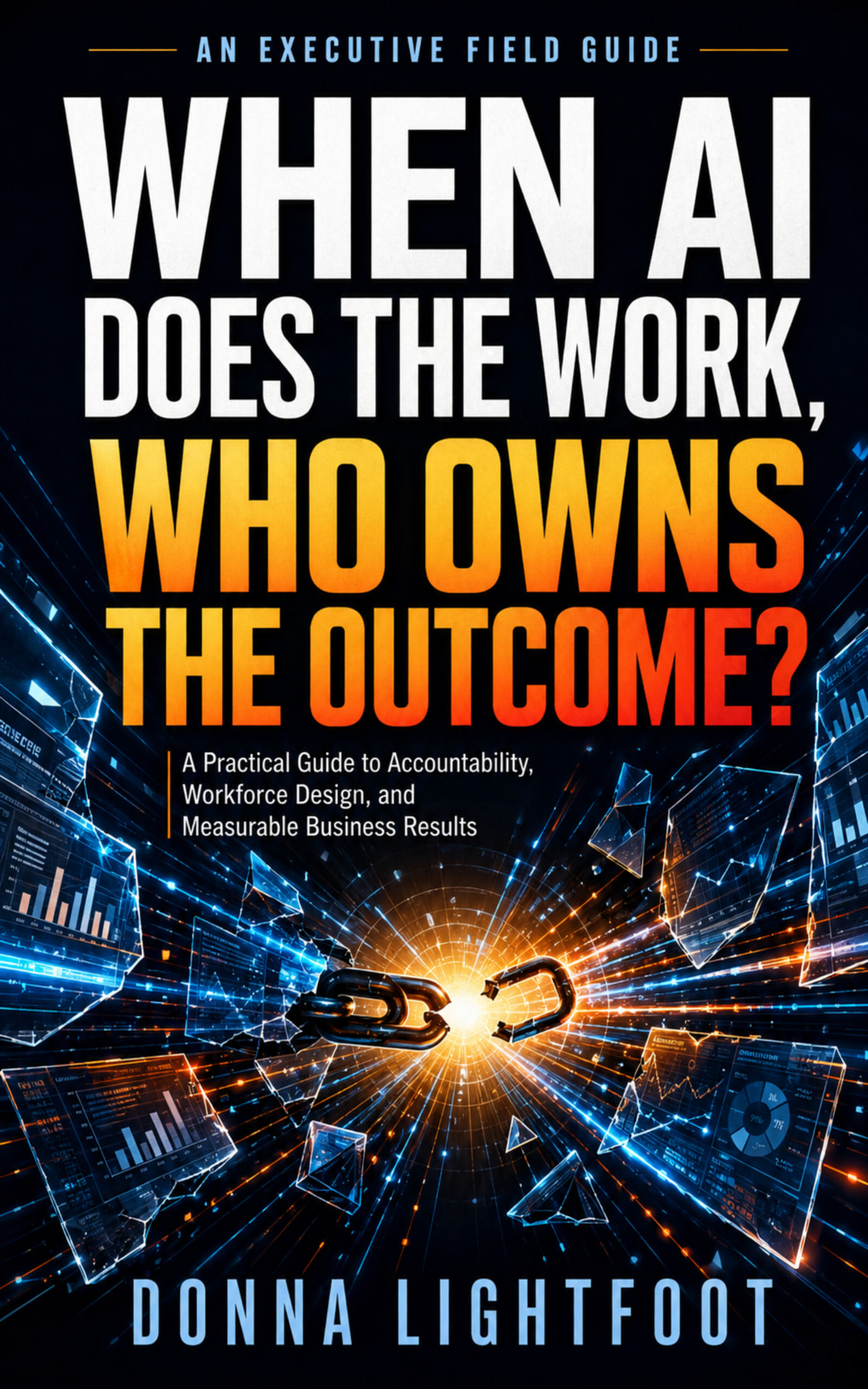
When AI Does the Work, Who Owns the Outcome?
A Practical Guide to Accountability, Workforce Design, and Measurable Business Results — Donna Lightfoot
AI Accountability: From AI Activity to Business Outcomes
AI is changing who — and what — performs the work inside organizations. But completing work and producing a successful outcome are not the same thing.
A system can answer a question without resolving the customer's need. It can contain an interaction while creating repeat demand. It can reduce visible labor while transferring work to customers, employees, supervisors, quality teams, or other departments. It can make one dashboard look better while increasing cost, complexity, risk, or effort somewhere else.
Building on Donna Lightfoot's Ownership Gap™ framework, the book gives executives and operational leaders a practical way to evaluate AI through the complete outcome rather than isolated technology metrics.
Outcome = Resolution + Cost + Experience
The book shows leaders how to determine whether AI actually eliminated work or merely moved it, distinguish containment from durable resolution, redesign workforce planning for human-and-AI operations, measure the true cost of AI-enabled outcomes, establish clear accountability and decision rights, improve quality management across humans and AI, and connect AI adoption to measurable enterprise value.
This is not a book about prompts, model architecture, or predicting the future of artificial intelligence. It is a field guide for operating AI responsibly in the real world.
From AI Activity to AI Outcomes
The Illusion of AI Success
Why adoption, utilization, containment, automated completion, and model accuracy do not automatically prove business value.
The New Ownership Gap
How AI distributes responsibility across technology, product, operations, workforce, quality, risk, vendors, and frontline employees while potentially leaving the complete outcome without a clear owner.
Containment Is Not Resolution
Why ending an automated interaction is different from proving that the customer's underlying need was correctly and durably resolved.
The Human + AI Workforce
The hybrid workforce is an operating model connecting digital capacity, human capacity, workflow, quality, decision rights, exception handling, and recovery — not simply a headcount calculation.
The True Cost of an AI Outcome
Include technology, human execution, oversight, correction, escalation, governance, recovery, and transferred work when evaluating AI economics.
AI Accountability
Every material AI-enabled outcome requires a clearly accountable business owner with sufficient visibility and authority.
Did AI Eliminate the Work — or Move It?
Every AI-enabled workflow changes work in one of four ways. Naming which one applies is the first step toward an honest outcome measurement.
A Field Guide, Not an AI Theory Book
Every chapter addresses an operating question and concludes with an Executive Field Test that leaders can apply inside real organizations.
The book can support
- AI steering committees
- Operational readiness reviews
- AI governance discussions
- Vendor evaluations
- Quarterly business reviews
- Workforce planning
- Customer experience reviews
- Product reviews
- AI pilot evaluations
- Post-incident reviews
- AI investment and ROI discussions
The book also contains
- 10 implementation tools
- 18 composite executive scenarios
- AI Outcome Metric Dictionary
- Executive Question Bank
- AI Outcome Scorecard
- Executive Review Format
- Credibility Language for AI Claims
Stop Measuring AI in Isolation
Executives do not need hundreds of disconnected AI metrics. They need evidence that the system is producing the outcome the organization actually promised.
Resolution
Did the underlying need get completed correctly and durably?
Cost
What did the complete resolved outcome actually cost?
Experience
How much customer and employee effort was required?
Workforce
What work disappeared, changed, moved, or was created?
Risk
Did the outcome remain within acceptable operational and governance boundaries?
Value
Did the organization realize the business benefit the investment was supposed to create?
Without resolution, lower cost may simply describe cheaper failure.
The Ownership Gap Meets AI
The original Ownership Gap™ begins with an enterprise contradiction: every department can own part of the process while nobody fully owns the outcome.
AI makes that problem more consequential.
Responsibility for an AI-enabled workflow may be distributed among executives, technology teams, data teams, product leaders, operations, workforce management, quality, risk, compliance, vendors, frontline employees, and customers. Each group can perform its assigned responsibility while the organization still fails to own the complete result.
When AI Does the Work, Who Owns the Outcome? applies The Ownership Gap™ directly to AI-enabled operations and asks leaders to reconnect the five layers of enterprise execution:
The Ownership Gap™
Identifies the organizational problem: capable teams, fragmented ownership, unowned outcomes.
Read about the first book →When AI Does the Work, Who Owns the Outcome?
Applies that problem to AI-enabled work, workforce design, governance, and outcome measurement.
About Donna Lightfoot
Donna Lightfoot is an operational intelligence, AI-powered customer experience, product marketing, competitive intelligence, and workforce strategy leader with more than twenty years of experience across healthcare, retail, enterprise operations, workforce management, and customer-experience technology.
Her career has included work with Blue Cross Blue Shield, Medtronic, Aetna/CVS Health, Walmart, Humana, Playvox/NICE, and Aspect/Alvaria.
Donna is the creator of The Ownership Gap™, an operating framework explaining why organizations can meet departmental targets while failing to own complete customer and business outcomes. Her work connects five layers of enterprise execution: Data → Workflow → Decision Intelligence → Operational Outcomes → Business Outcomes. Her operating philosophy is grounded in a practical equation: Outcome = Resolution + Cost + Experience.
Donna writes about AI readiness, operational intelligence, human-and-AI workforce design, contact centers, healthcare administrative workflows, product marketing, competitive intelligence, and measurable enterprise execution. Technology matters. But the outcome is the strategy.
Frequently asked questions
What is When AI Does the Work, Who Owns the Outcome about?
It is an executive field guide examining how organizations maintain accountability when AI begins performing work previously handled by people. It focuses on measurable outcomes, workforce design, governance, resolution, cost, experience, risk, and business value.
What is AI outcome ownership?
AI outcome ownership means assigning accountability for the complete customer or business result rather than only the technology or task performed by AI.
Is AI containment the same as resolution?
No. Containment indicates that an interaction ended inside an automated channel. Resolution requires evidence that the underlying need was completed correctly and durably.
How should organizations measure AI success?
The book recommends evaluating AI across six connected dimensions: Resolution, Cost, Experience, Workforce, Risk, and Value.
Does AI automatically reduce workforce requirements?
No. AI may eliminate some work while accelerating, transferring, or creating other work. Workforce planning should account for exception handling, oversight, quality, recovery, changing complexity, and new skill requirements.
Who should read this book?
The book is designed for executives and leaders responsible for AI, operations, customer experience, workforce management, product, transformation, quality, governance, risk, and enterprise performance.
Where can I buy When AI Does the Work, Who Owns the Outcome?
The book is available now on Amazon at https://www.amazon.com/dp/B0HH8CWF62.
How does this book relate to The Ownership Gap?
The Ownership Gap™ explains how organizations can optimize individual functions without anyone owning the complete outcome. When AI Does the Work, Who Owns the Outcome? applies that framework directly to AI-enabled work.