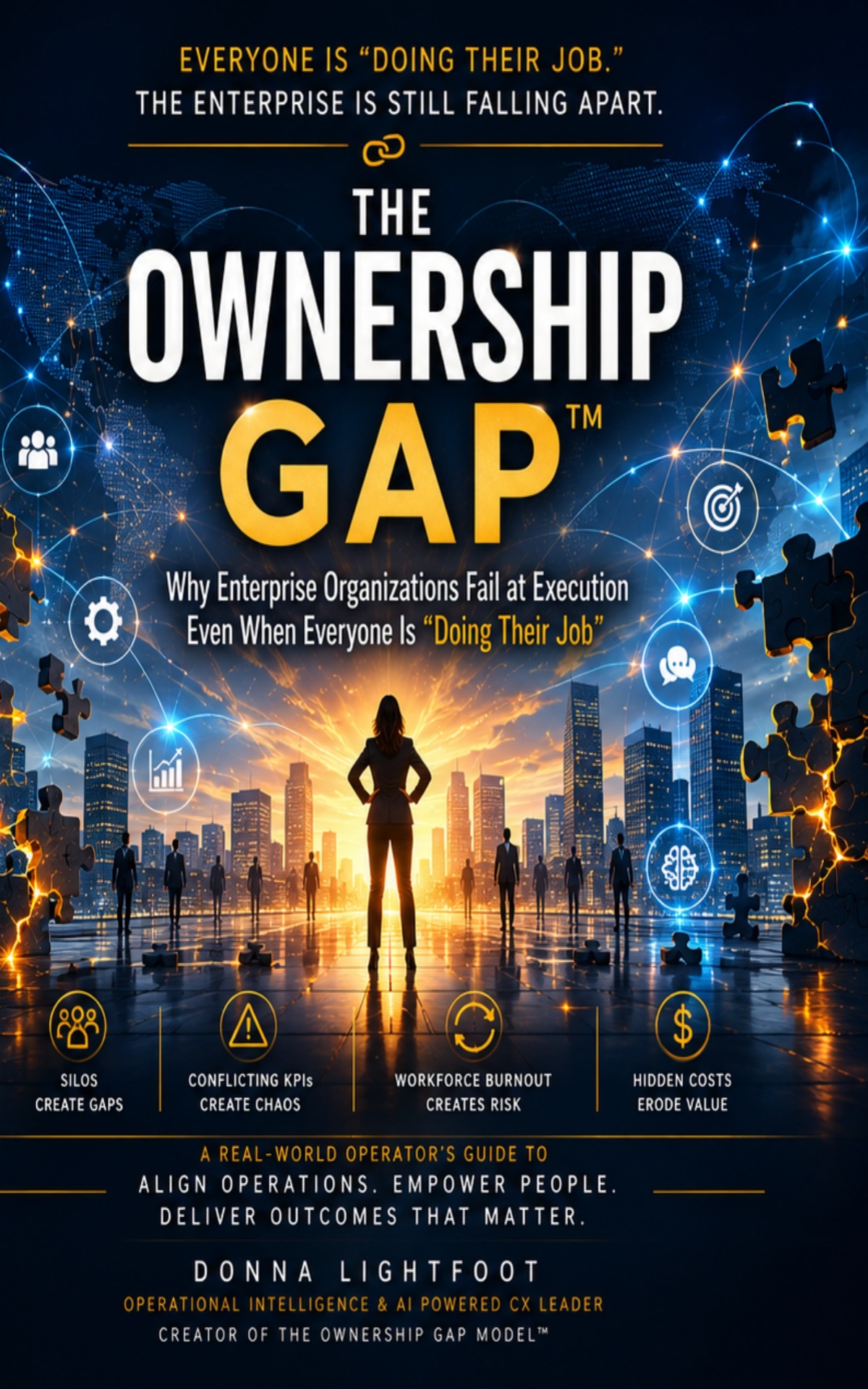
What is Operational Intelligence™?
Operational Intelligence™ is the discipline of understanding how operational decisions impact customer experience, workforce sustainability, and business outcomes together — not as isolated dashboards or siloed KPIs. It is the connective layer between workforce strategy, governance alignment, customer experience operations, and enterprise execution. For organizations pursuing AI transformation, Operational Intelligence™ is the prerequisite to AI readiness: AI cannot fix fragmented operations, it can only scale them.
AI Readiness & Operational Maturity
AI readiness is not a tooling question — it is an operational maturity question. Enterprises with fragmented operations, misaligned KPIs, and unclear ownership accelerate dysfunction when they deploy AI. The Ownership Gap™ outlines an AI operational readiness model that assesses governance maturity, workflow continuity, workforce intelligence, and cross-functional alignment before scaling AI-enabled operations. Sustainable enterprise AI strategy requires operational alignment first.
Enterprise Operational Alignment
Enterprise operational alignment is the connective tissue between strategy, workforce execution, customer experience continuity, and governance. Without it, organizations live inside The KPI War™ — competing metrics that quietly create hidden operational drag, escalation volume, and workforce burnout. Alignment is engineered through operational governance, shared accountability for end-to-end outcomes, and outcome-based workforce management.
Outcome-Based Workforce Management
Traditional WFM optimizes volume and average handle time. Outcome-Based Workforce Management optimizes resolution, customer effort reduction, and total cost — rebuilding forecasting, scheduling, and workforce analytics around the business outcomes that matter. It is the workforce optimization model required for AI-powered customer experience, workforce sustainability, and enterprise customer continuity.
Governance Alignment & Operational Trust
Enterprise AI governance, operational accountability, and governance maturity are the foundation of operational trust. The Ownership Gap™ provides a governance alignment framework that connects enterprise systems alignment, operational KPI alignment, and organizational accountability — so transformation programs deliver measurable, durable outcomes instead of transformation fatigue.
Customer Experience Continuity & Operational Visibility
Customer journey fragmentation, repeat demand, and escalation management are symptoms of weak operational visibility. Operational continuity — across contact center operations, enterprise workflow continuity, and customer operations strategy — is how leaders deliver customer experience transformation that actually compounds. The book gives leaders a CX operational strategy and operational execution framework grounded in real enterprise practice.