Thought Leadership

Executive POV on enterprise operating models, AI-powered CX, workforce strategy, and the next decade of customer operations.

Articles, frameworks, and strategic perspective written for operators, product leaders, and executives shaping enterprise transformation and operational governance.

Featured Series · Executive POV

Operator-grounded perspective on AI-powered CX, workforce strategy, and the next decade of contact center operations.

Operations6 min read

Silent Killers of Contact Center Performance

Repeat contacts, failure demand, and hidden operational inefficiencies don't show up on dashboards — but they're quietly destroying unit economics and service-level performance.

Business implication

If you only measure volume and AHT, you're measuring the symptoms. The real cost lives in the work you should never have created in the first place.
Career & Operations5 min read

From the Floor to Market

Why the most effective product marketing in CCaaS and WEM comes from people who've actually run contact center operations — and what gets lost when it doesn't.

Business implication

Operator credibility shortens the distance between buyer pain and product positioning. It's the unfair advantage.

Product Marketing5 min read

Most Product Marketing Doesn't Fail — Messaging Fails

Failed launches are almost never product failures. They're messaging failures: positioning that talks about features when the buyer is making an outcome decision.

Business implication

Rebuild the message around the buyer's measurable outcome and the same product starts winning deals it was losing.

Market Analysis7 min read

Verint + Calabrio Consolidation Analysis

What the consolidation wave across WEM and AI-powered CX really tells us about category maturity, buyer behavior, and where the next category fight will happen.

Business implication

Buyers don't want suites — they want outcomes. Consolidation only wins when the integrated promise actually shows up operationally.

AI-Powered CX6 min read

Why AI-Powered CX Still Struggles With Operational Ownership

Most AI-CX rollouts fail not because the model is bad, but because nobody owns the outcome. The Ownership Gap is the single biggest blocker to measurable AI ROI in service.

Business implication

Until AI sits inside a clear operational ownership model — with resolution, cost, and experience as the KPIs — the savings stay theoretical.

Workforce Strategy5 min read

Outcome-Based WFM: Why Volume × AHT Is Broken

Traditional WFM optimizes for cost-to-serve as a forecast. Outcome-based WFM optimizes for resolution, experience, and total cost — and rebuilds scheduling around the outcomes that actually matter.

Business implication

Once you replace volume × AHT with outcome modeling, you start scheduling for the business you want — not the queue you have.

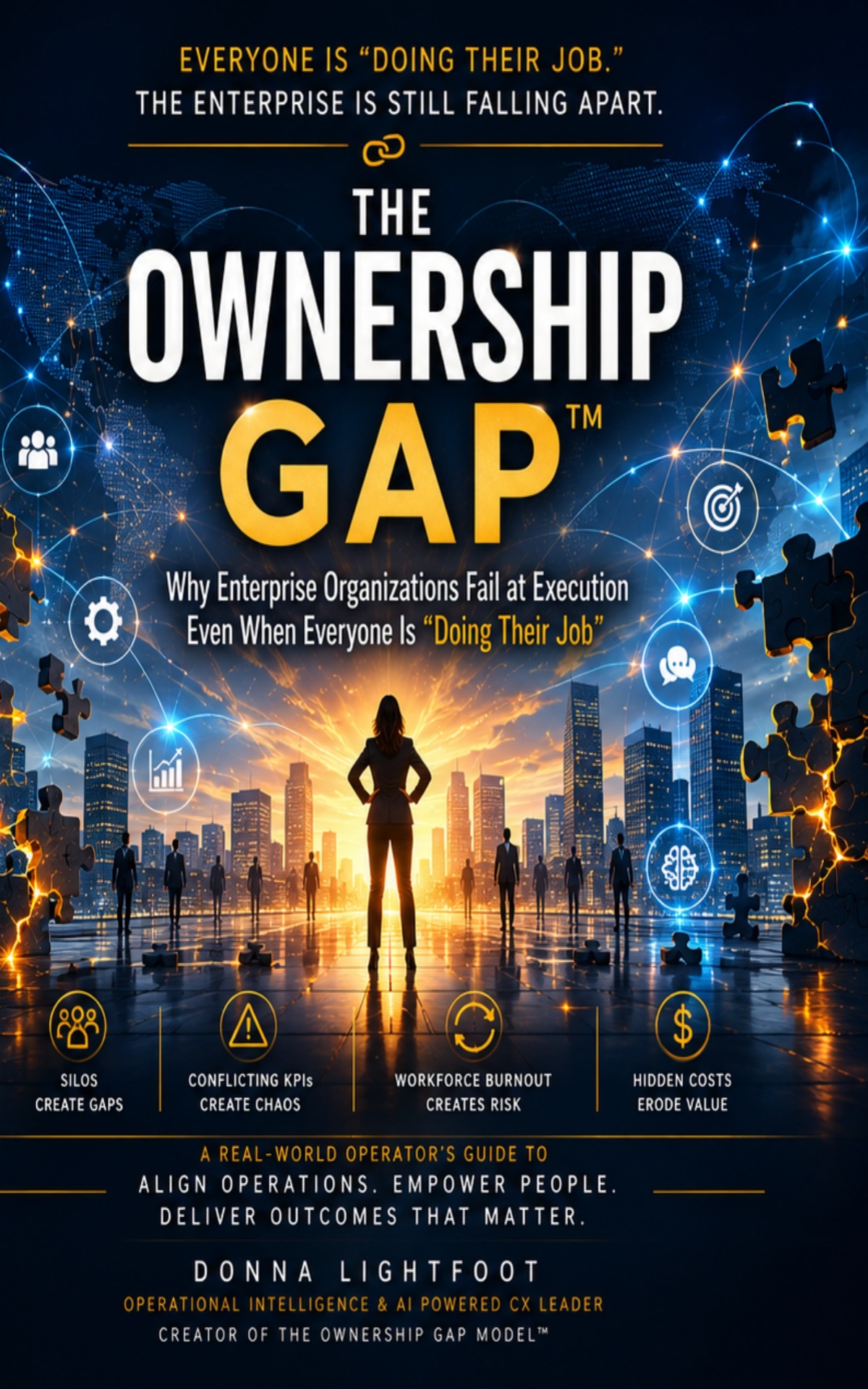
The Ownership Gap by Donna Lightfoot — book cover
New Book · Featured Publication

The Ownership Gap™ — why enterprise execution breaks even when everyone is doing their job.

A practical guide for leaders accelerating AI, automation, and digital transformation — introducing operational frameworks to resolve the fragmented ownership undermining enterprise execution.

Contrarian POV · Differentiated Insight

Five things most operators get wrong about modern CX operations.

The category rewards conventional wisdom. The operating reality rewards the opposite. These are the contrarian positions that shape every framework, transformation, and AI-powered CX engagement I lead.

Workforce MetricsPOV · 01
Conventional view

Service level proves operational health.

Operator reality

Service level measures answer speed — not resolution, not experience, not cost-to-serve. Hitting SL while repeat contacts climb means the operation is failing in slow motion.

AI in CXPOV · 02
Conventional view

AI automatically improves CX operations.

Operator reality

Without operational ownership, AI scales the existing inefficiency. Automating bad workflows just creates faster, cheaper failure demand — and obscures who's accountable for the outcome.

Operational IntelligencePOV · 03
Conventional view

Dashboards reveal operational reality.

Operator reality

Dashboards aggregate. Friction hides between rows — in repeat contacts, escalation loops, rework cycles, and handoffs that never get counted. The most expensive work is the work no metric tracks.

WEMPOV · 04
Conventional view

WEM programs optimize performance.

Operator reality

Most WEM programs optimize activity — schedule adherence, QA scores, shrinkage — not outcomes. Until quality, workforce, and performance share one outcome signal, the program manages effort, not results.

Product MarketingPOV · 05
Conventional view

Strong messaging is enough to win.

Operator reality

PMM fails without operational context. If the buyer's pain is operational and the message is about features, you lose the deal — and you never know why. Operator credibility is the unfair advantage.

Future of AI-Powered CX

The next operating model for customer experience is being designed right now.

A forward-looking view on where AI-powered CX is heading — and the operating decisions enterprise leaders need to make now to be credible in 24 months.

01 · Workforce Strategy

AI-powered workforce strategy

Workforce planning shifts from headcount math to capacity orchestration — humans, AI agents, and automation modeled as a single operating system tuned to outcomes, not occupancy.

02 · Orchestration

Operational orchestration

The next decade of CX is won at the orchestration layer: routing work — not just contacts — across humans, copilots, and autonomous agents based on intent, risk, and resolution probability.

03 · Workflow Intelligence

Workflow intelligence

Real-time visibility into how work actually moves — where it stalls, repeats, or escalates. Workflow intelligence replaces dashboards that measure activity with systems that measure flow.

04 · Autonomy

Autonomous operational systems

Self-correcting operations that detect failure demand, rebalance capacity, and trigger workflow changes without waiting for a quarterly review. Autonomy with guardrails — not autonomy without accountability.

05 · Governance

AI governance in CX operations

Clear ownership for model behavior, escalation thresholds, and customer-facing decisions. Governance becomes an operating discipline — not a compliance checkbox bolted on after launch.

06 · Human + AI

Human + AI operating models

Roles redesigned around judgment, escalation, and exception handling. The leaders who win will define what humans uniquely do — and engineer everything else for AI-native execution.

Operator Perspective

"The organizations that win the next decade of CX won't have the most AI. They'll have the clearest ownership of what AI is accountable for."

LinkedIn Traction

Conversation moving the category forward.

Articles read and discussed by CCaaS, WEM, and AI-powered CX leaders — sparking conversation across product, GTM, and operations executives.

6+

Published long-form articles on AI-powered CX, WFM, and PMM strategy

Executive

Engagement from CCaaS, WEM, and contact-center leadership

Active

Comment threads with operators, product, and PMM peers

Want a guest article, a webinar, or a keynote?

I speak and write on AI-powered CX, workforce transformation, and competitive intelligence.

Get in touch